What Is PBIS (Sunnah Expectations)?
Positive Behavioral Interventions and Supports (PBIS), known at ACA as Sunnah Expectations, is a schoolwide framework that teaches, encourages, and reinforces positive behavior. Rooted in Islamic teachings, it guides students to practice respect, responsibility, compassion, and good character (akhlaq), following the example of Prophet Muhammad (peace be upon him).
What Are the Expected Outcomes?
- A Positive School Environment: Create a safe, respectful, and welcoming community where Islamic values are practiced daily.
- Improved Academic Success: Reduce behavioral disruptions and help students stay focused on learning.
- Strong Islamic Character: Encourage students to develop good manners, self-discipline, and moral character in accordance with the Sunnah.
- Stronger Relationships: Build trust, understanding, and mutual respect among students, staff, and families.
- Consistent Expectations: Ensure students understand schoolwide expectations and receive fair, consistent responses to their behavior.
Why Is PBIS Important at a Private Islamic School?
At Arizona Cultural Academy, education extends beyond academic achievement. We strive to nurture students who grow intellectually, spiritually, and socially while developing a strong foundation in Islamic values.
Sunnah Expectations connect everyday school behavior with the teachings of Islam. By explicitly teaching and reinforcing positive behaviors, we help students make responsible choices, treat others with kindness, respect their community, and become positive contributors to society.
Sunnah Expectations are at the heart of our school culture. They guide students, teachers, staff, and families in building a community where Islamic values are reflected not only in what we learn, but also in how we treat one another every day.
Teaching System
As part of our commitment to Positive Behavioral Interventions and Supports (PBIS), our PBIS team conducts a structured “roll-out” to teach staff and students the core system twice a year. This roll-out involves teaching, reteaching, and reinforcing our school-wide behavioral expectations to ensure consistency and clarity.
This approach reinforces a positive learning environment and ensures every student understands and benefits from our behavioral standards.
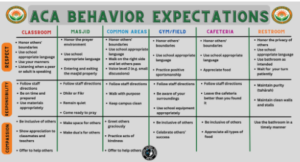
Core Sunnah Expectations: Respect, Responsibility, and Compassion
- Respect: Honor Allah (SWT), oneself, and others through words, actions, and attitudes.
- Responsibility: Take accountability for your actions and strive to fulfill your duties with excellence.
- Compassion: Show empathy and kindness, supporting others in their time of need.
These Sunnah Expectations are the cornerstone of our approach, guiding every school community member to uphold values that reflect the beauty of Islam.
Behavior Expectations — Important Points
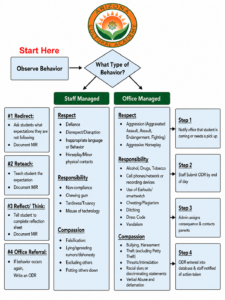
Objective: Establish a consistent, predictable, and fair system for responding to student behavior. Students should understand the consequences of their actions and learn responsibility, trust, and respect while helping maintain a safe and supportive school community.
Minor Behaviors — Classroom Managed
Chewing gum.
Defiance.
Disrespect or disruption.
Tardiness or truancy.
Dishonesty, lying, or spreading rumors.
Horseplay or minor physical contact.
Inappropriate language or behavior.
Misuse of technology.
Earbud or smartwatch use.
Non-compliance with school rules or policies.
Major Behaviors — Office Managed
Aggression, assault, endangerment, or fighting.
Aggressive horseplay.
Alcohol, drugs, or tobacco.
Bullying or harassment.
Cell phone violations.
Cheating or plagiarism.
Ditching class.
Misusing the fire alarm or tampering with cameras.
School threats involving bombs, chemicals, fire alarms, or other dangers.
Theft, excluding petty theft.
Threats or intimidation.
Racial slurs or discriminatory statements.
Uniform or dress code violations.
Vandalism or unauthorized entry.
Verbal abuse or defamation.
Weapons or dangerous items.
Why It Matters
Ensures students are treated fairly and consistently.
Helps students understand expectations and consequences.
Encourages responsibility and accountability.
Builds trust, respect, and a safe school environment.
Reinforces Sunnah values rooted in Islamic teachings, including respect, responsibility, and compassion, following the example of Prophet Muhammad (peace be upon him).
Practice and Reinforcement
Staff should respond to minor and major behaviors consistently according to the school’s behavior flowchart.
Classroom-managed behaviors should be addressed by teachers, while office-managed behaviors should be referred to the office.
Teachers and staff should explain expectations, provide appropriate consequences, and help students learn from their mistakes.
Review and reinforce behavior expectations regularly to maintain a safe, respectful, and supportive school community.
Classroom Responsibility — Important Points
Expectation: Students should be responsible by following directions, being prepared, and using classroom materials appropriately.
Follow staff directions: Listen to and follow teachers’ instructions.
Be on time and prepared: Arrive before class starts with all required materials ready.
Use materials appropriately: Use classroom resources for their intended purpose.
Why It Matters
Responsibility creates a positive learning environment and helps students develop habits that prepare them to become responsible citizens.
Examples of responsible behavior:
Arriving on time.
Having materials ready before class begins.
Staying focused and using resources correctly.
Non-examples:
Arriving late or skipping class.
Coming without required materials.
Playing with or misusing classroom resources.

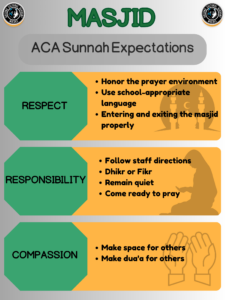
Masjid Expectations — Important Points
Expectation: Students should respect the masjid by following staff directions, engaging in Dhikr or Fikr, remaining quiet, and coming prepared to pray.
Follow staff directions: Enter, exit, and behave respectfully in the masjid.
Dhikr or Fikr: Use masjid time for remembrance of Allah (Dhikr) or reflection (Fikr).
Remain quiet: Avoid chatting, playing, and distractions.
Come ready to pray: Have wudu, appropriate clothing, and the right intention.
Why It Matters
The masjid is the house of Allah. Students should respect its sacred purpose and use their time there wisely by following the Sunnah of Prophet Muhammad (PBUH).
Examples of expected behavior:
Pray two rak‘ahs of Tahiyyat al-Masjid (when appropriate).
Stay engaged in Dhikr or Fikr.
Keep the masjid clean and organized.
Arrive prepared with wudu, appropriate clothing, and the intention to pray.
Non-examples:
Using phones, toys, or other distracting items.
Chatting or making unnecessary noise.
Bringing food or drinks into the masjid.
Wasting time or engaging in horseplay and wrestling.
Practice and reinforcement:
Teachers model appropriate and inappropriate scenarios and discuss the differences.
Students role-play respectful masjid behavior with peers and receive feedback.
During the first week of each semester, staff should give extra attention and frequent positive reinforcement when students demonstrate responsibility.
Teachers should reteach and review these expectations whenever needed.
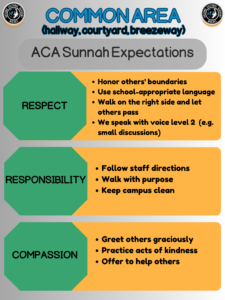
Common Area Expectations — Important Points
Expectation: Students should use hallways, breezeways, and courtyards responsibly by following staff directions, walking with purpose, and keeping the campus clean.
Follow staff directions: Listen to staff and follow instructions.
Walk with purpose: Walk safely on the right side, avoid running, and keep pathways clear.
Keep campus clean: Put trash in trash cans and use recycling bins when available.
Why It Matters
Responsible behavior in common areas shows respect for others, keeps the campus clean, and helps ensure everyone’s safety.
Examples of expected behavior:
Walking safely on the right side of hallways and breezeways.
Moving directly to class without unnecessary delays.
Keeping pathways clear for others.
Throwing trash away properly and using recycling bins.
Non-examples:
Running or bumping into students and staff.
Wandering aimlessly instead of heading to class.
Gathering in groups that block walkways.
Leaving trash in hallways or putting gum on walls.
Practice and reinforcement:
Teachers model appropriate and inappropriate hallway scenarios and discuss the differences.
Students create and act out their own scenarios with peers and receive feedback.
During the first week of each semester, staff should provide extra attention and frequent positive reinforcement when students demonstrate responsibility.
Teachers should reteach and review these expectations whenever needed.
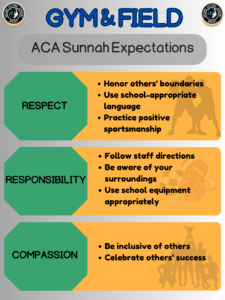
Gym & Field Expectations — Important Points
Expectation: Students should demonstrate responsibility by following staff directions, being aware of their surroundings, and using school equipment properly.
Follow staff directions: Listen to and follow instructions from teachers, coaches, and staff.
Be aware of your surroundings: Watch out for others and avoid running into students or engaging in horseplay.
Use school equipment properly: Handle equipment safely and use it for its intended purpose.
Why It Matters
Responsible behavior creates a safe environment where everyone can enjoy learning, playing, and participating in activities.
Examples of expected behavior:
Playing safely and responsibly.
Following teacher and coach instructions.
Waiting in line for equipment.
Being mindful of other students and avoiding unsafe behavior.
Non-examples:
Playing carelessly or recklessly.
Ignoring staff directions.
Running into others or engaging in horseplay.
Misusing school equipment.
Practice and reinforcement:
Teachers model appropriate and inappropriate scenarios and discuss the consequences of unsafe behavior.
Students create and act out their own scenarios with peers and receive feedback.
During the first week of each semester, staff should provide extra attention and frequent positive reinforcement when students demonstrate responsibility.
Teachers should reteach and review these expectations whenever needed.
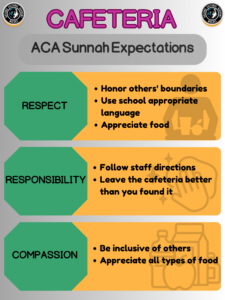
Cafeteria Expectations — Important Points
Expectation: Students should show respect by honoring others’ boundaries, using school-appropriate language, and appreciating food.
Honor others’ boundaries: Keep hands and feet to yourself, respect personal space, and treat others kindly.
Use school-appropriate language: Speak politely, use a moderate voice level, and avoid teasing, insults, or bullying.
Appreciate food: Treat food respectfully and avoid wasting it or using it as a toy.
Why It Matters
Respectful behavior helps create a safe, positive school environment. Harassment, bullying, and negative interactions can hurt others, disrupt learning, and cause problems at school and in the community.
Examples of expected behavior:
Offering to help others.
Using appropriate language and a moderate voice level.
Asking an adult for help when a conflict cannot be resolved.
Keeping hands and feet to yourself.
Apologizing and helping when you accidentally cause a problem.
Non-examples:
Pushing, shoving, or yelling.
Invading another person’s personal space.
Throwing away food unnecessarily.
Playing with food.
Insulting others or spreading rumors.
Practice and reinforcement:
Teachers model respectful and disrespectful scenarios, such as accidentally knocking over another student’s food tray.
Students practice responding respectfully by apologizing, taking responsibility, and offering to help.
Students create and act out their own scenarios with peers and receive feedback.
During the first week of each semester, staff should provide extra attention and frequent positive reinforcement when students demonstrate respect.
Teachers should reteach and review these expectations whenever needed, especially when disrespectful behavior becomes a concern.
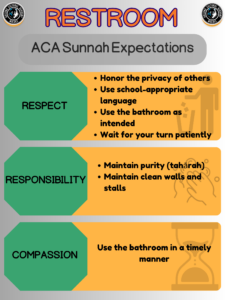
Restroom Expectations — Important Points
Expectation: Students should demonstrate responsibility by maintaining purity (tahārah), keeping the restroom clean, and respecting the privacy of others.
Maintain purity (tahārah): Follow proper restroom hygiene and cleanliness practices.
Keep the restroom clean: Leave walls, stalls, and facilities clean for others.
Use the restroom responsibly: Complete your needs promptly and return to class.
Practice good hygiene: Flush after use, wash your hands, and follow the Sunnah of entering with the left foot and exiting with the right foot.
Why It Matters
Responsible restroom behavior helps maintain a clean, safe, and private environment for everyone.
Examples of expected behavior:
Entering with the left foot and exiting with the right foot.
Using the restroom promptly.
Flushing the toilet after use.
Washing hands before leaving.
Keeping the restroom clean and respecting others’ privacy.
Non-examples:
Socializing or using a cellphone in the restroom.
Playing with soap, tissues, or water.
Engaging in horseplay or fighting.
Leaving the restroom dirty or damaging facilities.
Staying in the restroom to avoid class.
Practice and reinforcement:
Teachers model appropriate and inappropriate restroom scenarios and discuss responsible choices.
Students create and act out their own scenarios with peers and receive feedback.
During the first week of each semester, staff should provide extra attention and frequent positive reinforcement when students demonstrate responsibility.
Teachers should reteach and review these expectations whenever needed.